A signed DPA before any AI system connects
If you need the data processing agreement to be a precondition of connecting an AI system rather than a workstream running alongside it, that is the job this gate does. An ai_system in Auditrek gets no API key and no webhook secret until a dpa_confirmation carrying a signed_at value is recorded, and the check is enforced server-side on the connect endpoint.
Auditrek is not open yet, so anything on this page about what it does is what it is being built to do.
The order of operations most connect flows leave to chance
Connecting an inference pipeline to a logging layer takes an afternoon. Getting a data processing agreement signed takes weeks. In most tooling those two clocks run independently: an engineer generates an API key on a Tuesday, points a credit-decisioning, hiring-screening or clinical-triage pipeline at it, and the agreement lands in a contract repository some time the following month. Nobody can state, from the system itself, which of the two happened first.
That ambiguity is the part that becomes awkward later. The evidence you are assembling to document your AI systems carries the history of how it came to exist, and "we believe the DPA was in place by then" is a weaker sentence than most compliance functions want to be holding. It is weaker still when the payloads in question come from pipelines that touch identifiable people in financial, employment or clinical contexts, where the fields moving through the ledger are the ones you least want to have collected under an unsettled arrangement.
The GDPR frames processing carried out by a processor as something governed by a contract or other legal act binding the processor to the controller, at Article 28. We point at the article and stop there. What that means for your particular arrangements, your lawful basis and your record of processing activities is a question for you and your counsel.
Auditrek's answer to the sequencing problem is structural rather than procedural. There is no checklist item reminding someone to sort the paperwork out, and no banner asking an engineer to confirm that legal has finished. There is simply nothing for a pipeline to authenticate against until the DPA confirmation is recorded, because the API key and the webhook secret are outputs of that record rather than of a button.
How the gate works, step by step
- The ai_system exists before it is connected
A system can be registered and named in your org, with its platform, model id and model version, and no credential attached to it. In that state nothing can reach it: no API key has been issued, no webhook secret has been issued, and there is no credential for an inference pipeline to authenticate with.
- Record the dpa_confirmation against that system
On the connect screen for a system, a signed-in member of your organisation records the confirmation: the name of the person who signed and the document reference for the agreement. Recording it sets signed_at. The gate reads that one field, and until it is non-null the system stays unconnected regardless of what else has been configured around it.
- Call connect on the system
The connect action behind /systems/:id/connect checks dpa_confirmation.signed_at on the server before any credential is generated. The check sits in front of the issuing code rather than beside it, so there is no window in which a key exists and the confirmation does not.
- Unsigned returns 403 with a descriptive message
If signed_at is null, the connect endpoint responds 403 and names the reason. No credential of any kind is created on that path: the request fails before the issuing code runs, so there is no API key and no webhook secret in existence for that system.
- Signed issues the API key and the webhook secret
Once the confirmation is recorded with signed_at, connecting issues the credentials for that ai_system. From that point the credentials are the thing your pipeline holds, and their existence implies the record that had to precede them.
What can exist before signed_at is recorded
| Object | Where it comes from | Can it exist before signed_at is recorded |
|---|---|---|
| ai_system record | Registered in your org with name, platform, model id and version | Yes, in an unconnected state with no credential |
| dpa_confirmation | Recorded against that system with a signer name, a document reference and a signed_at value | This is the record the gate reads |
| API key | Issued by a successful connect call | No |
| Webhook secret | Issued by a successful connect call | No |
| SHA-256 hash-chained decision records | Written by accepted posts to the decision record API | No, there is no credential to authenticate an ingestion call with |
What you get from putting the gate at the connect endpoint
A sequence you can state plainly
Because no credential can exist before signed_at is recorded, the presence of an API key for a system carries the ordering with it. You are not reconstructing a timeline by comparing a contract repository against a key-issuance log.
Enforced on the server, not by the interface
The check lives on the connect endpoint and is covered by a test that it cannot be bypassed by client-side state. A patched front end, a replayed request or a stale page does not produce a key for an unsigned system.
Scoped per ai_system, not per vendor relationship
Adding a fourth model to your inventory means recording a confirmation for that system before it can send anything, rather than inheriting authorisation from a system connected two quarters ago.
A failure mode that names the missing field
The unsigned case is a 403 with a descriptive message rather than a silent no-op or a generic error. The engineer who hits it knows to go back to the compliance owner, and the compliance owner knows which field is not yet set.
No partial connection state
On the unsigned path no credential of any kind is ever created for that system, so there is no half-connected entry sitting in your inventory and no early decision records to account for.
Why the check sits on connect rather than in onboarding
Onboarding gates are easy to write and easy to lose. They usually live in a wizard, they usually run in the browser, and they usually apply once per organisation, which means the fifth system someone registers eighteen months later inherits a decision nobody remembers making.
Putting the check on the connect endpoint instead has three consequences worth being explicit about.
- The gate applies to every connection, including one made directly against the API rather than through the web interface.
- It applies per ai_system, so growth in your AI inventory does not quietly widen what the original arrangement was taken to cover.
- It reduces to a single assertion: call connect on a system whose signed_at is null, expect a 403 and no issued credential.
That last point is the practical one. A mechanism you can express as one test is a mechanism you can describe in one sentence, to a colleague, in an internal control register, or in your own words rather than ours.
What the confirmation records, and what it does not
The gate is strong about ordering and deliberately narrow about everything else. Being precise about the boundary matters more here than it does on most feature pages, because the field you are relying on is the one a supervisory authority or an internal auditor is most likely to ask about.
It is an attestation, not a document store
The confirmation is free text: the name of the person who signed and the document reference you give it. Recording it stamps signed_at at that moment. There is no document upload, no parsing of the agreement and no check for a countersignature. The register holds the assertion and its timestamp, and your own contract repository holds the paper.
Any signed-in member of your organisation can record it
The action is available to signed-in members of the org, and there is no separate approver or owner role in front of it today. If your internal control is that only the data protection owner records confirmations, that control lives in your process, not in a permission in the product. Sign-in is email and password, and access is scoped to your organisation.
There is no revocation path
A recorded confirmation cannot be withdrawn in the product, and withdrawing one would not invalidate credentials already issued for that system. If an arrangement lapses, the operative step is on your side: stop sending from that pipeline and record the change in your own register. We would rather name that gap than imply a lifecycle the code does not have.
Auditrek does not supply the agreement
There is no standard data processing agreement published by Auditrek for its own customers to sign today. The gate records that your agreement exists, by signer name and reference, and declines to issue credentials without that record. Which agreement, with which parties, on whose template, is yours to decide.
What happens after the system is connected
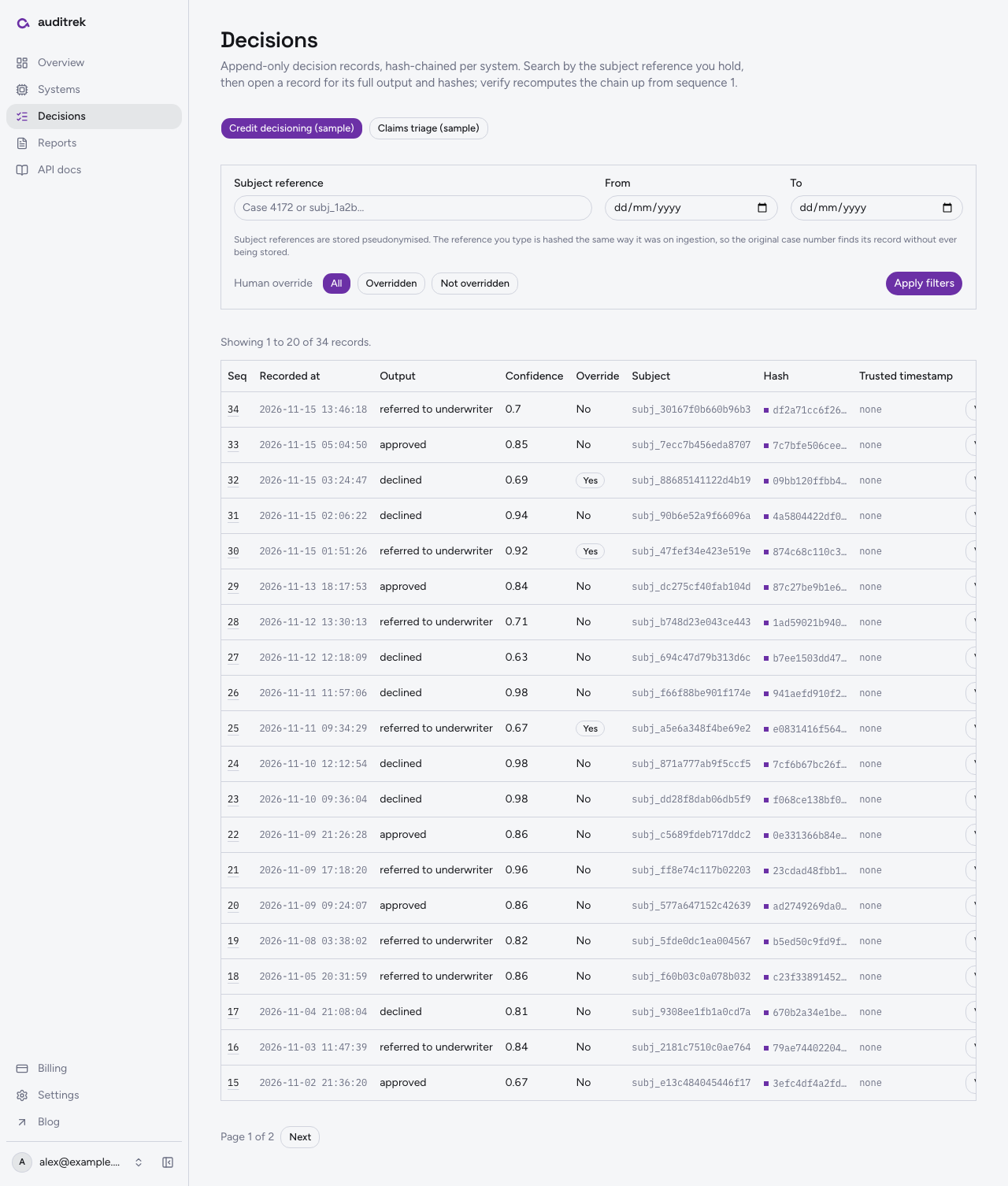
Once credentials exist, the decision record API accepts inference event payloads over REST or webhook: input hash, model id and version, output, confidence, timestamp and the human override flag. Each accepted record is written as a SHA-256 hash-chained, append-only entry for that ai_system, with the sequence number and previous hash computed from the last record in the chain. Raw model inputs never arrive, only their hash.
The same ingestion path carries a data-minimisation gate. Payloads containing recognisable raw sensitive fields are rejected with a 422 before any database write, and subject identifiers are pseudonymised by default. That pairing is deliberate: the DPA confirmation settles the arrangement, and the ingestion gate limits what travels under it.
From there, the dashboard shows decisions logged, systems connected, the last report generated and tamper-verification status, and the report generator produces PDF and HTML output for a chosen system and date range, mapped to EU AI Act Article 12 and 13 fields. Every generated report carries a visible disclaimer stating that it does not constitute legal advice and has not been reviewed by qualified regulatory counsel. The sibling pages in this pillar cover the report generator and the Article 12 field list in detail, so this page stays on the gate that has to close first.
Where this sits today
Auditrek is being built for compliance officers at mid-market regulated enterprises who already know which of their AI systems fall in scope and need the evidence layer under them to behave predictably. The DPA gate is part of the first release rather than a later addition, because a ledger whose earliest records predate its own processing arrangement is a ledger with an awkward first page.
The facts a diligence reviewer will ask for, stated plainly. The service is hosted on Amazon Web Services in a single region, with no multi-region replication and no choice of data residency. Alongside AWS it uses Stripe for payments and subscriptions, Amazon SES for password reset, email verification and organisation invite messages, and Sentry. People sign in with email and password; there is no single sign-on. There is no SOC 2 or ISO 27001 certification, and no independent cryptographic review of the hash chain implementation.
Billing runs per organisation through Stripe against the count of connected ai_systems. Starter is €1,500 a month for 2 connected AI systems and 50,000 decision records a month. Growth is €3,500 a month for 5 connected systems and 500,000 decision records a month. Both plans declare a 30-day free trial with no card to start.
We are not open yet. If the sequencing problem on this page is one you are currently solving with a spreadsheet and a reminder in someone's calendar, join the waitlist and tell us how many systems you expect to connect in your first quarter. That number is shaping what we build next.
Nothing on this page is legal advice, and none of it has been reviewed by qualified regulatory counsel. It describes a mechanism in the product and the ordering that mechanism enforces. The regulation texts referenced above are linked in the sources and are worth reading in the original.
Questions
What exactly does Auditrek check before connecting an AI system?
One field. The connect endpoint reads dpa_confirmation.signed_at for that ai_system and requires it to be non-null before it will issue an API key or a webhook secret. If the value is null, the endpoint returns 403 with a descriptive message and no credential is created.
Can an engineer connect a pipeline before the DPA is recorded?
Not through the interface and not through the API. The check runs server-side on the connect endpoint and is covered by a test that it cannot be bypassed by client-side state, so a modified front end or a direct request produces the same 403.
Does Auditrek supply a standard data processing agreement to sign?
Not today. There is no standard DPA published by Auditrek for its own customers, and the gate does not provide one. What it records is your confirmation that an agreement is signed, as a signer name, a document reference and a signed_at timestamp held against that system.
Does Auditrek review or approve my data processing agreement?
No. The confirmation is self-attested: free-text signer name and document reference, stamped with the time it was recorded. There is no document upload and no assessment of terms, lawful basis or obligations. That judgement stays with you and your counsel.
Can a DPA confirmation be revoked, and what happens to keys already issued?
There is no revocation path in the product today, and withdrawing a confirmation would not invalidate credentials already issued for that system. If an arrangement lapses, stop sending from that pipeline and record the change in your own register.
Is the gate per organisation or per AI system?
Per ai_system. A confirmation recorded for one system does not connect another, so each new model added to your inventory passes through the same check before it can send anything. Any signed-in member of your organisation can record a confirmation; there is no separate approver role on that action.
How does the gate relate to the data-minimisation checks at ingestion?
They sit at different points. The DPA gate controls whether a system can be connected at all. The data-minimisation gate runs on every decision record posted, rejecting payloads with recognisable raw sensitive fields with a 422 before any database write and pseudonymising subject identifiers by default.
Where does the data sit, and what does it cost?
Hosting is Amazon Web Services in a single region, with no multi-region replication and no choice of data residency. Starter is €1,500 a month for 2 connected AI systems and 50,000 decision records a month; Growth is €3,500 a month for 5 systems and 500,000 records a month. Both declare a 30-day free trial with no card to start.